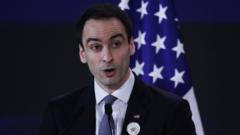
White House memo claims mass AI theft by Chinese firms
```json { "title": "White House Accuses China of Mass AI Model Theft", "metaDescription": "The White House OSTP issued a memo accusing Chinese firms of industrial-scale AI distillation campaigns targeting U.S. frontier AI models like Claude and ChatGPT.", "content": "<h2>White House Accuses China of Industrial-Scale AI Theft in Landmark Government Memo</h2>\n\n<p>The White House Office of Science and Technology Policy (OSTP) issued a formal memo on April 23, 2026, accusing foreign entities — primarily based in China — of running deliberate, industrial-scale campaigns to steal U.S. frontier artificial intelligence systems through a technique known as adversarial distillation. The memo, titled <em>Adversarial Distillation of American AI Models</em>, was authored by Michael Kratsios, Director of the OSTP and Assistant to the President for Science and Technology, and distributed to federal agency heads. It marks the first time the U.S. government has formally elevated what had previously been a commercial dispute between AI companies into an explicit matter of national security policy.</p>\n\n<p>The memo was first reported by the Financial Times and quickly confirmed by multiple outlets including Reuters, CNN, CNBC, and Axios. Its release comes weeks before President Trump's scheduled visit to Beijing to meet with Chinese President Xi Jinping, a summit originally planned for late March but postponed to May 14 — lending the accusations a sharp diplomatic edge.</p>\n\n<h2>What the Memo Says: Proxy Accounts, Jailbreaking, and Stripped Safety Protocols</h2>\n\n<p>According to Axios, the Kratsios memo accused mostly China-based actors of using proxy accounts to evade detection and jailbreaking techniques to expose proprietary information and extract capabilities from American AI models. The Trump administration said the campaigns use tens of thousands of proxy accounts to systematically harvest AI capabilities while avoiding identification.</p>\n\n<p>Kratsios stated directly: <em>"The U.S. has evidence that foreign entities, primarily in China, are running industrial-scale distillation campaigns to steal American AI. We will be taking action to protect American innovation."</em></p>\n\n<p>The memo went beyond commercial concerns, warning that adversarial distillation enables foreign actors to undermine AI safety. As Kratsios wrote: <em>"These distillation campaigns also allow those actors to deliberately strip security protocols from the resulting models and undo mechanisms that ensure those AI models are ideologically neutral and truth-seeking."</em></p>\n\n<p>The memo also drew a sharp rhetorical line against the notion that these practices constitute legitimate open-source development: <em>"There is nothing innovative about systematically extracting and copying the innovations of American industry, and there is nothing open about supposedly open models that are derived from acts of malicious exploitation."</em></p>\n\n<p>The OSTP announced plans to share intelligence with U.S. AI companies about the distillation campaigns — including the tactics employed and the actors involved — and said the administration would explore measures to hold foreign actors accountable, according to CNN.</p>\n\n<p>While framing adversarial distillation as a serious threat, the memo also acknowledged that the underlying technique is not inherently problematic. According to CNBC, the Kratsios memo noted that distillation can play a <em>"vital"</em> role when legitimately used to produce smaller, lighter-weight models from more advanced systems. The concern is specifically with unauthorized, large-scale extraction designed to replicate frontier capabilities without the underlying research and development investment.</p>\n\n<h2>Anthropic and OpenAI Had Already Sounded the Alarm</h2>\n\n<p>The White House memo did not emerge in a vacuum. By February 2026, both Anthropic and OpenAI had already accused Chinese AI firms of conducting large-scale distillation attacks on their models — accusations that now form part of the evidentiary backdrop for the government's intervention.</p>\n\n<p>Anthropic formally accused three Chinese AI companies — DeepSeek, Moonshot AI, and MiniMax — of using approximately 24,000 fake user accounts to carry out 16 million automated interactions with its Claude AI model. The scale of the alleged operation, as reported by Shepherd Gazette, points to a coordinated and systematic effort rather than opportunistic probing.</p>\n\n<p>OpenAI made similar allegations before U.S. lawmakers in February 2026, testifying that Chinese companies are employing distillation methods to free-ride on the research and development investments of U.S. frontier AI labs, according to Shepherd Gazette.</p>\n\n<p>According to Axios, both OpenAI and Anthropic had previously identified DeepSeek, Moonshot AI, and MiniMax as being behind wide-scale distillation attacks on their models — making these three firms the most publicly named targets in the growing dispute.</p>\n\n<p>The controversy around DeepSeek stretches back to early 2025, when the company's R1 model surprised the global AI industry by reportedly matching frontier U.S. performance at a fraction of the cost. DeepSeek's R1 was reported to have been developed at a training cost of approximately $5.6 million — a figure that prompted widespread scrutiny about how such results were achieved and whether unauthorized distillation of U.S. models played a role.</p>\n\n<h2>The Broader National Security Context</h2>\n\n<p>The OSTP memo arrives against a backdrop of escalating concerns about Chinese economic espionage targeting the U.S. technology sector. In 2024, the Justice Department indicted a former Google software engineer for stealing AI trade secrets and sharing them with two Chinese companies, according to Axios — an indication that the threat encompasses not only digital intrusion but insider activity as well.</p>\n\n<p>The Commission on the Theft of American Intellectual Property estimates that Chinese IP theft costs the U.S. economy between $225 billion and $600 billion annually. The FBI currently has over 2,000 active investigations tied to Chinese economic espionage, with a new case opened roughly every 10 hours, according to statements attributed to FBI Director Christopher Wray.</p>\n\n<p>These figures provide the wider law enforcement and economic context within which the AI distillation allegations sit — though the OSTP memo is specifically focused on the AI sector and the novel threat posed by adversarial model distillation at industrial scale.</p>\n\n<h2>Expert Reactions: Industry and Diplomatic Pushback</h2>\n\n<p>Sarah Heck, Anthropic's Head of Public Policy, welcomed the memo's framing. According to the Washington Examiner, Heck stated: <em>"Industrial-scale distillation attacks are a serious national security threat. We need to have more of a spotlight on this issue, and look forward to continuing to collaborate on maintaining American AI leadership."</em></p>\n\n<p>The Chinese Embassy in Washington rejected the accusations. A spokesperson for the Chinese Embassy in the U.S. told The Hill: <em>"China has always been committed to promoting scientific and technological progress through cooperation and healthy competition."</em> The Embassy also said it <em>"opposes the unjustified suppression of Chinese companies by the U.S."</em> and that <em>"China attaches great importance to the protection of intellectual property rights."</em></p>\n\n<p>The dueling responses reflect a wider pattern in U.S.-China technology disputes, where Washington frames its actions in terms of national security and IP protection, while Beijing characterizes them as competitive protectionism dressed up in security language.</p>\n\n<h2>What Comes Next: Policy, Summits, and Unanswered Questions</h2>\n\n<p>The memo's release just weeks before the Trump-Xi summit on May 14 raises immediate questions about how the AI theft allegations will factor into diplomatic negotiations. The U.S.-China tech rivalry had shown signs of partial de-escalation following a detente brokered in late 2025, but the OSTP memo introduces a new and pointed grievance into the relationship at a sensitive moment.</p>\n\n<p>The administration has said it will share information with U.S. AI companies about the tactics and actors involved in distillation campaigns and will explore accountability measures for foreign actors. What those measures look like in practice — whether export controls on AI hardware, restrictions on API access, or legal action — remains to be specified.</p>\n\n<p>For U.S. AI companies, the memo represents a significant development: the government is now formally aligned with their position that adversarial distillation is not merely a terms-of-service violation but a national security issue warranting federal response. Whether that alignment translates into concrete protections for proprietary AI systems — and how quickly — will determine how much practical difference the memo makes for companies like Anthropic and OpenAI, which have already been dealing with these attacks for well over a year.</p>\n\n<p>The naming of DeepSeek, Moonshot AI, and MiniMax in prior company allegations, combined with the government's formal acknowledgment of the problem, also raises the question of whether targeted sanctions or other punitive measures against specific Chinese AI firms are on the table — though the OSTP memo stops short of naming specific companies itself.</p>\n\n<p>For more tech news, visit our <a href=\"/news\">news section</a>.</p>", "excerpt": "The White House Office of Science and Technology Policy issued a formal memo on April 23, 2026, accusing Chinese firms of running industrial-scale campaigns to steal U.S. frontier AI systems through adversarial distillation. Authored by OSTP Director Michael Kratsios, the memo names the practice a national security threat and pledges government action. The announcement comes weeks before a scheduled Trump-Xi summit and follows formal accusations by Anthropic and OpenAI against DeepSeek, Moonshot AI, and MiniMax.", "keywords": ["AI model theft", "adversarial distillation", "White House OSTP", "China AI espionage", "Michael Kratsios"], "slug": "white-house-accuses-china-industrial-scale-ai-theft-2026" } ```