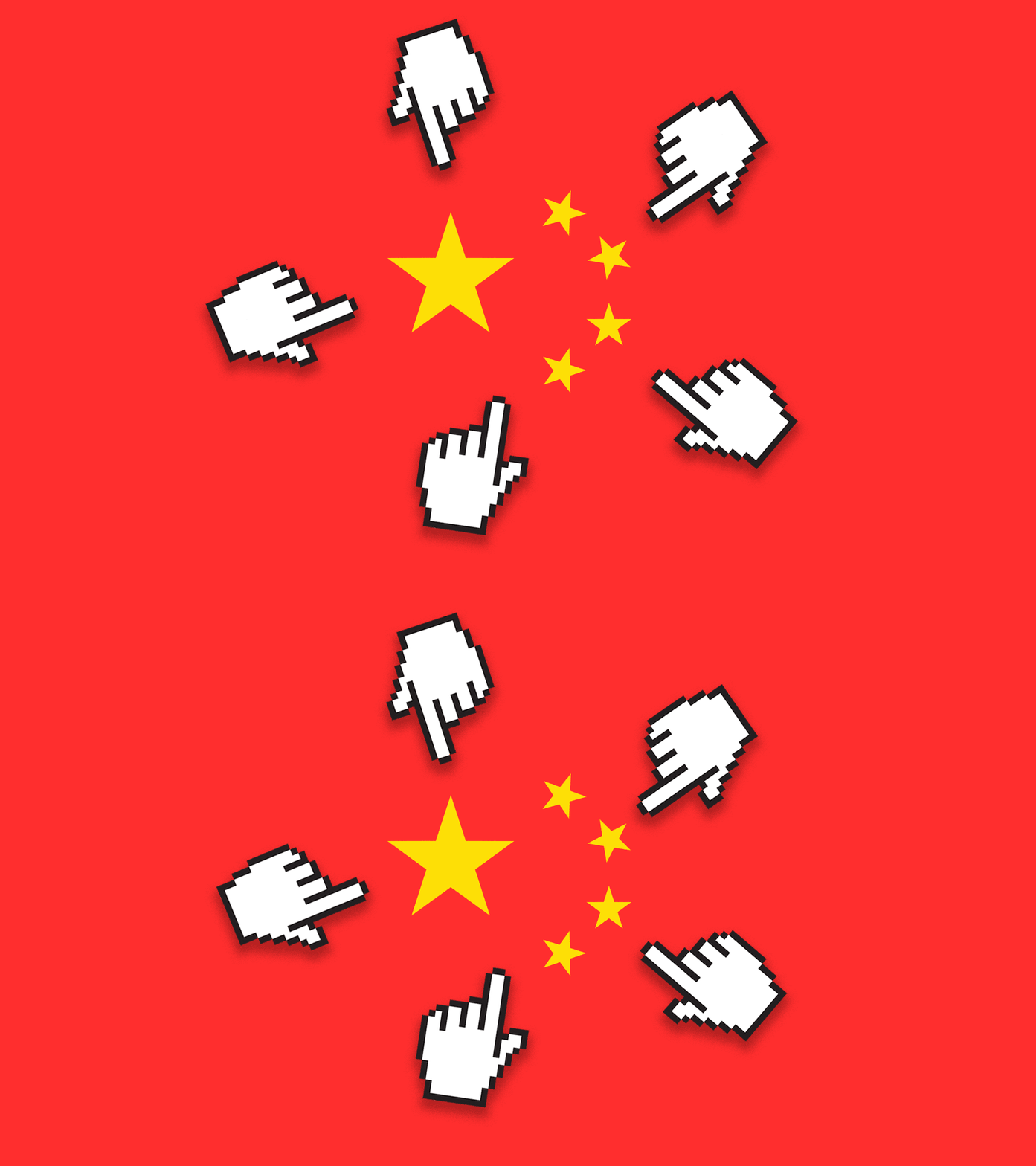
U.S. Accuses China of Industrial-Scale AI Theft
White House Accuses China of 'Industrial-Scale' Campaigns to Steal U.S. AI Secrets
The Trump administration formally accused China on April 23, 2026, of conducting coordinated, large-scale efforts to steal American artificial intelligence technology — a significant escalation in the U.S.-China AI rivalry that arrives just weeks before President Donald Trump is scheduled to meet Chinese President Xi Jinping in Beijing.
The accusation was delivered through a memo written by Michael Kratsios, director of the White House Office of Science and Technology Policy (OSTP), addressed to federal agency heads. The memo alleges that actors principally based in China are exploiting technical loopholes, fake accounts, and commercial proxy networks to extract the capabilities of frontier U.S. AI systems — a practice known as knowledge distillation — at a scale the administration describes as unprecedented.
The OSTP Memo: What the White House Is Alleging
In the memo, Kratsios stated: "The US government has information indicating that foreign entities, principally based in China, are engaged in deliberate, industrial-scale campaigns to distil US frontier AI systems."
According to reporting citing the Financial Times, the memo noted that Chinese campaigns were leveraging tens of thousands of proxy accounts to evade detection, alongside jailbreaking techniques designed to expose proprietary information embedded in U.S. AI models.
The administration stated it intends to share intelligence on these distillation campaigns directly with American AI companies to help them coordinate defenses against such attacks. The White House also indicated it would explore measures to hold foreign actors accountable for industrial-scale distillation campaigns, though specific mechanisms were not detailed in the memo.
The timing is geopolitically charged. Trump's Beijing visit, scheduled for May 14 and 15, 2026, was already postponed once from an original date of March 31–April 2 due to the U.S.-Israel war with Iran. The formal AI theft accusation — issued weeks before the summit — has the potential to inject additional friction into diplomatic preparations at a moment when technology competition is expected to be a central topic of discussion.
Anthropic Named DeepSeek, Moonshot AI, and MiniMax in February
The White House memo builds on a wave of public allegations from major U.S. AI companies that began gaining momentum in February 2026. Anthropic became the first major American AI laboratory to publicly name specific Chinese firms, accusing three labs — DeepSeek, Moonshot AI, and MiniMax — of orchestrating coordinated distillation campaigns against its Claude models.
In a company statement, Anthropic said: "We have identified industrial-scale campaigns by three AI laboratories — DeepSeek, Moonshot, and MiniMax — to illicitly extract Claude's capabilities to improve their own models."
The scale of the alleged operation was substantial. Anthropic stated: "These labs created over 24,000 fraudulent accounts and generated over 16 million exchanges with Claude, extracting its capabilities to train and improve their own models."
According to Anthropic's official blog post published February 23, 2026, the three laboratories used commercial proxy services running so-called 'hydra cluster' architectures — sprawling networks of fraudulent accounts that distribute traffic across APIs and third-party cloud platforms — to bypass Claude's access restrictions in China. In one case identified by Anthropic, a single proxy network managed more than 20,000 fraudulent accounts simultaneously.
The breakdown of activity across the three accused labs, according to data cited by VentureBeat and NYU RITS referencing Anthropic's findings, was significant in scope. MiniMax drove the largest volume of distillation traffic, accounting for over 13 million of the 16 million total exchanges. Moonshot AI ran the second-largest operation, generating over 3.4 million exchanges, with activity targeting agentic reasoning and tool use, coding and data analysis, computer-use agent development, and computer vision.
Anthropic described the technical methodology in a statement cited by CNBC: "Once access is secured, the labs generate large volumes of carefully crafted prompts designed to extract specific capabilities from the model."
OpenAI, Google, and xAI Also Filed Formal Complaints
Anthropic was not alone. According to congressional testimony documents from the House Select Committee on Strategic Competition between the U.S. and the Chinese Communist Party, dated April 16, 2026, all major U.S. AI companies — including Google, Anthropic, and xAI — accused Chinese companies of leveling distillation attacks against their systems.
OpenAI submitted a letter to the same committee in February 2026, accusing Chinese firms including DeepSeek of using what it described as sophisticated, multi-stage pipelines to steal American AI capabilities through distillation attacks, per congressional testimony documents.
Additionally, according to an analysis published by Just Security, as early as 2024, Microsoft security researchers had observed individuals allegedly affiliated with DeepSeek exfiltrating large volumes of data through the OpenAI API — suggesting the alleged campaigns predated the public disclosures by a considerable margin.
What Is Knowledge Distillation — and Why It Matters
At the center of these allegations is a technique called knowledge distillation, a well-established method in AI development in which a smaller 'student' model is trained to replicate the behavior of a larger, more powerful 'teacher' model. The student model learns from the outputs of the teacher, acquiring capabilities at a fraction of the cost of training from scratch.
When used internally or with explicit permission, distillation is a legitimate and widely practiced technique. What U.S. officials and AI companies are alleging, however, is its adversarial application: querying American frontier models at industrial scale using fraudulent accounts and proxy networks, harvesting the outputs as training data, and using that data to build competing systems without incurring the full research and development costs.
The technique became a prominent flashpoint in early 2025 when DeepSeek released its R1 reasoning model. The model appeared to match leading U.S. systems at dramatically lower development cost, raising concerns among U.S. officials and industry executives that years of American AI investment could be rapidly replicated by foreign competitors through distillation rather than independent innovation.
Researchers at UC Berkeley illustrated the concern in stark terms: according to VentureBeat, they said they recreated OpenAI's reasoning model for just $450 in 19 hours following DeepSeek's release — a data point that underscored how quickly distillation techniques could compress the gap between frontier and follower models.
Congressional Action and Regulatory Pressure
The allegations have also reached Capitol Hill. The House Foreign Affairs Committee passed a series of bills aimed at limiting China's ability to close the gap in the AI race. One proposal would require the administration to consider placing companies involved in distillation attacks on the U.S. entity list — a designation that would significantly restrict their access to American technology and partners.
A separate regulatory instrument, the BIS Affiliates Rule — designed to automatically extend U.S. export restrictions to entities at least 50 percent owned by already-listed parties — is currently suspended until November 2026 as part of the broader U.S.-China trade truce, according to the Just Security analysis. Its suspension limits one avenue that might otherwise have been used to address the distillation campaigns through existing export control frameworks.
Expert Reactions
Dmitri Alperovitch, chairman of the Silverado Policy Accelerator and co-founder of CrowdStrike, offered a direct assessment of the situation in commentary published by Just Security: "It's been clear for a while now that part of the reason for the rapid progress of Chinese AI models has been theft via distillation of U.S. frontier models."
What Comes Next
The White House has signaled it will pursue multiple tracks in response. On the intelligence-sharing front, the administration has committed to providing American AI companies with information about foreign distillation attempts to help them harden their defenses. On the accountability front, it has stated an intention to explore punitive measures, though the specific tools — whether export controls, entity list designations, sanctions, or diplomatic pressure — remain to be defined.
Congress is independently advancing legislative options, including the entity list proposal from the House Foreign Affairs Committee. Whether those bills advance through the full legislative process, and on what timeline, remains to be seen.
The most immediate variable is the Trump-Xi summit. The meeting in Beijing on May 14 and 15 was already navigating a complicated diplomatic landscape shaped by trade tensions and the U.S.-Israel conflict with Iran. The OSTP memo's public release — framing Chinese AI activity as deliberate, state-adjacent industrial espionage — adds another layer of complexity to those preparations. Whether the administration uses the summit to press China directly on AI theft, or treats the memo as a domestic policy signal rather than a diplomatic opening move, will shape how this episode develops in the weeks ahead.
For more tech news, visit our news section.
Why This Matters for Productivity and Innovation
The race to control frontier AI isn't just a geopolitical contest — it directly shapes the tools that professionals and organizations rely on to work smarter, stay healthy, and make better decisions. When the integrity of AI systems is compromised through large-scale data theft, it affects the reliability and trustworthiness of the technology that underpins modern productivity platforms. Staying informed about developments at the intersection of AI, policy, and security is increasingly part of navigating a smarter, healthier relationship with technology. Join the Moccet waitlist to stay ahead of the curve.