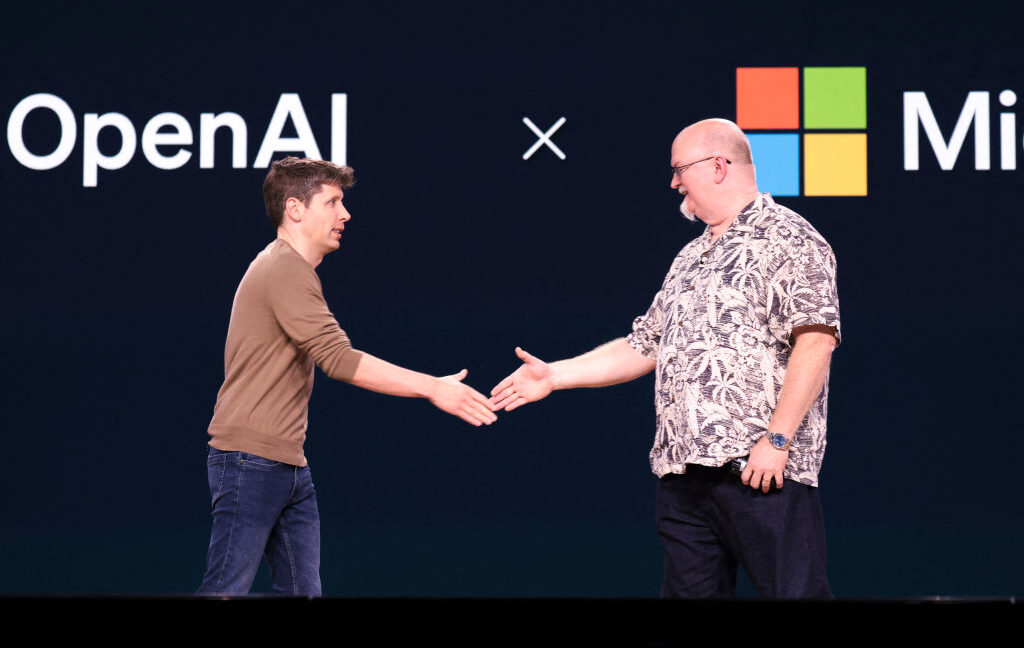
OpenAI ends its exclusive partnership with Microsoft
```json { "title": "OpenAI Ends Microsoft Exclusivity, Opens to AWS and Google", "metaDescription": "Microsoft and OpenAI amended their partnership on April 27, 2026, ending exclusivity and allowing OpenAI models to run on Amazon Bedrock and other clouds.", "content": "<h2>OpenAI Ends Exclusive Microsoft Partnership, Clearing the Way for Amazon and Google Cloud Access</h2><p>In a landmark shift for the artificial intelligence industry, Microsoft and OpenAI announced an amended partnership agreement on April 27, 2026, making Microsoft's license to OpenAI's intellectual property non-exclusive. The restructured deal allows OpenAI to serve all of its products to customers across any cloud provider — including Amazon Web Services and Google Cloud — while preserving Microsoft Azure's status as OpenAI's primary cloud partner with first access to new products. The agreement resolves months of legal tension and reshapes the competitive landscape of enterprise AI.</p><h2>What Changed: The Key Terms of the Amended Agreement</h2><p>Under the original partnership, Microsoft held exclusive rights to license and distribute OpenAI's models and intellectual property — a commercial advantage that had been central to Azure's growth during the early AI boom. That exclusivity is now gone. According to Microsoft's official blog and CNBC, Microsoft retains its non-exclusive IP license through 2032, and Azure remains OpenAI's primary cloud provider. However, OpenAI is now free to distribute its full product portfolio through competing cloud platforms.</p><p>The revenue-sharing structure has also been significantly revised. OpenAI will continue paying Microsoft a revenue share at the same 20% rate, per a source familiar with the agreement, but those payments will now be subject to a total cap and will run only through 2030. In exchange, Microsoft will no longer pay a revenue share to OpenAI — a meaningful change to what had been a two-way financial arrangement.</p><p>One of the more consequential removals in the amended deal is the so-called AGI clause. Previously, this provision required Microsoft to determine whether OpenAI had achieved artificial general intelligence, with that determination serving as a trigger for changing the terms of the relationship. According to CNBC and The Next Web, that clause has been eliminated entirely, removing a source of governance ambiguity that had long attracted scrutiny from observers and competitors alike.</p><p>As OpenAI put it in its corporate statement: <em>"Today, we are announcing an amended agreement to simplify our partnership and the way we work together, grounded in flexibility, certainty, and a focus on delivering the benefits of AI broadly."</em></p><h2>Amazon Bedrock Access and the $50 Billion AWS Partnership</h2><p>The amended agreement directly enables a deal that had been legally precarious since it was announced. In February 2026, OpenAI struck a multi-year $38 billion infrastructure partnership with AWS — later expanded by an additional $100 billion over the next eight years. Amazon also agreed to invest up to $50 billion in OpenAI, beginning with an initial $15 billion followed by a further $35 billion contingent on certain conditions being met.</p><p>According to TechCrunch, the prior exclusive Microsoft agreement had exposed OpenAI to a potential breach-of-contract claim over that AWS deal. The April 27 amendment resolves that legal risk.</p><p>With the exclusivity barrier lifted, Amazon moved quickly. Amazon CEO Andy Jassy posted on X that AWS will make OpenAI models available to clients through the Amazon Bedrock service in the coming weeks. <em>"With this, builders will have even more choice to pick the right model for the right job,"</em> Jassy wrote.</p><p>Jassy had also commented at the time of the February partnership announcement: <em>"We have lots of developers and companies eager to run services powered by OpenAI models on AWS, and our unique collaboration with OpenAI to provide stateful runtime environments will change what's possible for customers building AI apps and agents."</em></p><p>OpenAI CEO Sam Altman, speaking to the infrastructure rationale behind the AWS partnership, noted: <em>"Scaling frontier AI requires massive, reliable compute."</em></p><h2>What This Means for Microsoft — and Its Investors</h2><p>Microsoft has invested more than $13 billion in OpenAI since 2019. As of October 2025, its stake in OpenAI's for-profit arm was valued at $135 billion, representing roughly 27% of the company on an as-converted diluted basis. That financial relationship remains intact — but the competitive moat Microsoft enjoyed through exclusivity does not.</p><p>Markets reflected the ambivalence. Microsoft shares fell approximately 1% following the announcement on April 27. That reaction, while modest, came against a backdrop in which Microsoft stock had already lost around 20% over the prior six months, while shares of cloud competitors Amazon and Google had climbed 17% and 30% respectively in the same period. The exclusivity arrangement was widely seen as one of Azure's structural advantages during that stretch, and its removal will be closely watched by investors and enterprise cloud customers alike.</p><p>There is, however, a counterargument to the bearish read on Microsoft's position. Last quarter, Microsoft reported making $7.5 billion in a single quarter from its investment in OpenAI — a figure that underscores the ongoing financial value of the relationship even as its exclusive terms are wound back. Azure retaining first-mover access to new OpenAI products is not nothing, even if it is no longer a monopoly.</p><p>OpenAI's revenue chief Denise Dresser had flagged the strategic problem with the old arrangement in an internal memo earlier in April 2026, writing that the exclusivity arrangement had <em>"limited our ability to meet enterprises where they are."</em> The amended deal is a direct response to that constraint.</p><h2>Industry Implications: AI Model Distribution Becomes a Multi-Cloud Market</h2><p>The practical effect of the restructured deal is that the market for OpenAI's models — which include the GPT-4 family and beyond — will now function more like a conventional multi-cloud software market. Enterprises that have built their infrastructure on AWS or Google Cloud will no longer need to route through Azure to access OpenAI's most capable models. This is likely to accelerate adoption among organizations that had previously faced friction or vendor lock-in concerns.</p><p>For Amazon Bedrock specifically, adding OpenAI models to its catalog meaningfully expands what is already one of the most comprehensive AI model marketplaces in cloud computing. Bedrock allows developers to access foundation models from multiple providers through a single API, and OpenAI's inclusion makes the platform substantially more competitive with Azure OpenAI Service.</p><p>Google Cloud's position is also worth noting. While the amended agreement does not specifically detail Google Cloud arrangements, OpenAI can now serve products across any cloud provider — and Google's stock performance over the prior six months suggests investor confidence in its competitive standing in the enterprise AI market.</p><p>The removal of the AGI clause carries its own significance beyond the commercial terms. That provision had embedded Microsoft into OpenAI's governance in an unusual way, giving the company interpretive authority over a threshold — artificial general intelligence — that remains undefined and contested across the research community. Its elimination simplifies OpenAI's governance structure at a moment when the company is reportedly considering a future public offering.</p><h2>Analysts See IPO Path Clearing</h2><p>Wedbush analysts characterized the restructuring in terms that look beyond the immediate deal terms. In a statement cited by Proactive Investors, the firm said: <em>"We believe this puts OpenAI on a strong path forward to going public through IPO given its clearer opportunity in the cloud environment while reducing significant barriers from its original partnership with Microsoft."</em></p><p>The logic is straightforward: a company with a single dominant cloud distribution partner, a complex revenue-sharing arrangement, and a governance clause tied to an undefined AGI threshold is a harder IPO candidate than one operating with multi-cloud flexibility, a simplified revenue cap, and cleaner governance. The amended agreement moves OpenAI materially in that direction.</p><h2>What Comes Next</h2><p>In the near term, the most concrete development to watch is the rollout of OpenAI models on Amazon Bedrock, which Andy Jassy indicated would happen within weeks. How quickly enterprise customers migrate workloads — or begin running parallel deployments across Azure and AWS — will be an early indicator of whether the exclusivity arrangement had been suppressing demand or simply shaping it.</p><p>Microsoft retains its position as OpenAI's primary cloud partner with first access to new products, and its non-exclusive IP license runs through 2032. The revenue share OpenAI pays to Microsoft continues through 2030. These terms suggest the two companies remain deeply intertwined even as the relationship becomes less restrictive.</p><p>Whether the amended structure ultimately strengthens or weakens Microsoft's position in the enterprise AI market will depend heavily on how Azure's first-access advantage translates into commercial terms — and how aggressively AWS and Google Cloud compete for OpenAI-powered workloads once the exclusivity barrier is down.</p><p>For more tech news, visit our <a href="/news">news section</a>.</p><h2>AI at Work: Why This Matters for Productivity</h2><p>The shift to multi-cloud AI model distribution means that businesses and individuals building AI-powered productivity tools will have more flexibility to access OpenAI's capabilities through their preferred infrastructure. Greater competition among cloud providers tends to drive down costs and improve reliability — both of which matter directly to the performance of the AI tools increasingly embedded in daily work and health management workflows. At Moccet, we track how developments like this translate into real gains for how people work, focus, and perform. <a href="/#waitlist">Join the Moccet waitlist to stay ahead of the curve.</a></p>", "excerpt": "Microsoft and OpenAI announced an amended partnership on April 27, 2026, ending Microsoft's exclusive license to OpenAI's intellectual property and allowing OpenAI models to be distributed through any cloud provider, including Amazon Web Services and Google Cloud. The deal resolves legal tension created by OpenAI's $50 billion Amazon partnership and removes the controversial AGI clause from the original agreement. Analysts at Wedbush say the restructuring clears a significant path toward a potential OpenAI IPO.", "keywords": ["OpenAI Microsoft partnership", "Amazon Bedrock OpenAI", "OpenAI exclusivity ends", "multi-cloud AI models", "OpenAI IPO"], "slug": "openai-ends-microsoft-exclusivity-amazon-bedrock-aws" } ```