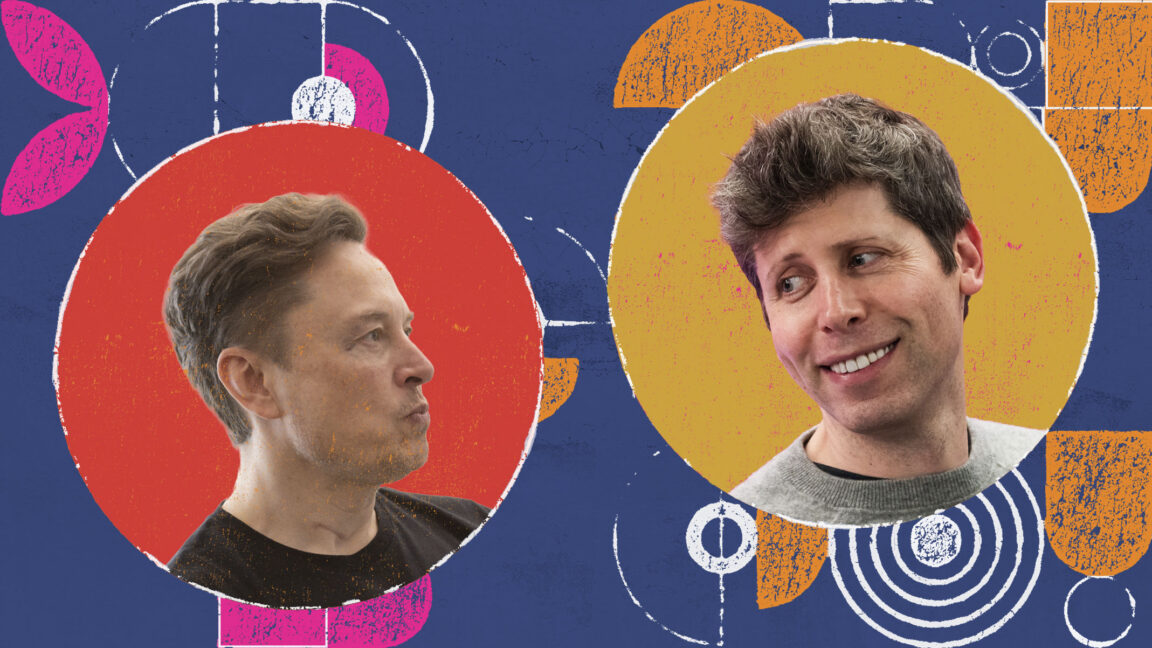
Musk and Altman face off in trial that will determine OpenAI's future
```json { "title": "Musk vs. Altman Trial: OpenAI's Future on the Line", "metaDescription": "Jury selection begins April 28 in Musk v. Altman, the federal trial that could reshape OpenAI's $852B future. Here's what you need to know.", "content": "<h2>Musk v. Altman Trial Begins: The Lawsuit That Could Reshape OpenAI's $852 Billion Future</h2>\n\n<p>Jury selection kicked off Monday, April 28, 2026, in one of the most consequential technology lawsuits in recent memory. The federal civil trial of <strong>Musk v. Altman</strong> is now underway at the U.S. District Court for the Northern District of California in Oakland, presided over by Judge Yvonne Gonzalez Rogers, with opening arguments expected to begin Tuesday. At the center of the case: whether OpenAI's transformation from a nonprofit charity into a for-profit juggernaut constitutes a betrayal of its founding mission — and whether Elon Musk is owed anything for his early role in building it.</p>\n\n<p>The trial pits two of the most powerful figures in artificial intelligence against each other. Musk, who co-founded OpenAI in 2015 alongside Sam Altman and others, left the company's board in 2018 and later launched his own rival AI venture, xAI, which was subsequently merged with SpaceX. Altman, who has led OpenAI from a scrappy nonprofit to a company valued at $852 billion according to court documents, now faces claims that he and co-founder Greg Brockman misappropriated a charitable enterprise for private gain.</p>\n\n<h2>What Musk Is Claiming — and What He's Asking For</h2>\n\n<p>Musk filed suit against Altman, Brockman, and a long list of co-defendants in 2024, seeking restitution he later estimated at $134 billion. Shortly before trial, however, he voluntarily dropped his fraud and constructive fraud claims, narrowing the case from 26 claims to two: <strong>breach of charitable trust</strong> and <strong>unjust enrichment</strong>. Microsoft is named as a co-defendant, accused of aiding and abetting OpenAI's alleged breach of charitable trust.</p>\n\n<p>According to court filings described by GeekWire, Judge Gonzalez Rogers summarized the formal charges to the jury pool as follows: Musk alleges breach of charitable trust and unjust enrichment against Altman, Brockman, and OpenAI, and aiding and abetting breach of charitable trust against Microsoft.</p>\n\n<p>The trial carries an unusual procedural structure. The jury serves in an advisory capacity on liability questions, but Judge Gonzalez Rogers retains sole authority over any remedy. In March, she ruled that Musk's $134 billion damages calculation can be presented to the jury, despite expressing skepticism about the methodology. She also blocked OpenAI from questioning Musk about alleged ketamine use during proceedings.</p>\n\n<p>The four-week trial is scheduled to run through May 22, with the jury expected to begin deliberations around May 12. Witnesses expected to take the stand include Musk, Altman, Brockman, Microsoft CEO Satya Nadella, former high-ranking OpenAI executives, and Shivon Zilis, a former OpenAI board member.</p>\n\n<h2>The Evidence: A Diary Entry, an Internal Email, and a Company's Origin Story</h2>\n\n<p>OpenAI was established in 2015 as a nonprofit charity with the stated mission of creating artificial intelligence to benefit humanity. Musk was its biggest individual early financial backer, contributing more than $44 million to the startup, according to court documents. He and Altman served as founding co-chairs.</p>\n\n<p>In 2019, OpenAI established a for-profit subsidiary to attract the capital required to compete in AI development. Then, in October 2025, it completed a full restructuring, converting that subsidiary into a public benefit corporation (PBC). Under that arrangement, Microsoft received a 27% stake and the nonprofit OpenAI Foundation received a 26% stake. OpenAI recently closed a $122 billion funding round, and The Wall Street Journal has reported it is planning an IPO, potentially later in 2026. Court documents state the company now has nearly 1 billion weekly active users.</p>\n\n<p>Musk's legal team argues that this transformation represents a fundamental betrayal of the original charitable mission he helped fund. Two pieces of evidence have drawn particular attention from the court.</p>\n\n<p>The first is a 2017 diary entry by Greg Brockman, which Judge Gonzalez Rogers has described as among the most damaging evidence in the case. In it, Brockman wrote: <em>"I cannot believe that we committed to non-profit if three months later we're doing b-corp then it was a lie."</em></p>\n\n<p>The second is an internal Microsoft email from March 2018, in which Microsoft CTO Kevin Scott wrote to CEO Satya Nadella: <em>"I wonder if the big OpenAI donors are aware of these plans?"</em> — a message that Musk's legal team argues shows Microsoft had early knowledge of the shift away from OpenAI's nonprofit structure.</p>\n\n<p>OpenAI's defense counters that Musk was not an innocent bystander to these discussions. According to Yahoo Finance, OpenAI has argued that Musk himself pushed for a for-profit structure, wanting to merge OpenAI with Tesla and install himself as CEO. When Altman and Brockman rejected that proposal, OpenAI claims, Musk cut ties and formed xAI as a competing lab. Musk has denied this characterization.</p>\n\n<h2>What's at Stake Beyond the Courtroom</h2>\n\n<p>The stakes in Musk v. Altman extend well beyond the two principals. OpenAI and SpaceX — which acquired xAI — are valued at over $2 trillion combined on the private market, according to CNBC. A ruling against OpenAI could complicate or delay a planned IPO, disrupt its relationship with Microsoft, and raise broader legal questions about how AI companies structured as nonprofits can transition to profit-seeking entities.</p>\n\n<p>Judge Gonzalez Rogers cleared the case for jury trial in a January 15, 2026 ruling, finding what she described as "ample evidence" supporting Musk's claims and rejecting nearly every attempt by OpenAI and Microsoft to dismiss the lawsuit before trial. That ruling signaled that, whatever the outcome, the case would force a public airing of OpenAI's internal deliberations during a pivotal period in its history.</p>\n\n<p>The trial also carries meaningful risks for Musk personally. As Al Jazeera reported on April 27, Musk was held liable last month by another jury for defrauding investors during his $44 billion takeover of Twitter in 2022. That backdrop gives both sides reasons to approach the proceedings carefully.</p>\n\n<p>Describing the dynamic as the trial opened, Judge Gonzalez Rogers offered her own terse framing to the courtroom: <em>"Billionaires versus billionaires."</em></p>\n\n<h2>Reactions: Combative Tone From Both Sides</h2>\n\n<p>On the day jury selection began, Musk took to X to post: <em>"Scam Altman and Greg Stockman stole a charity. Full stop."</em></p>\n\n<p>OpenAI responded via its official Newsroom account the same day, stating: <em>"This lawsuit has always been a baseless and jealous bid to derail a competitor."</em> The company also added: <em>"We can't wait to make our case in court where both the truth and the law are on our side."</em></p>\n\n<p>Tech journalist and Platformer founder Casey Newton offered a broader characterization of the confrontation: <em>"This is a clash of two enormous personalities in Elon Musk and Sam Altman."</em></p>\n\n<h2>What Comes Next</h2>\n\n<p>With opening arguments expected Tuesday and testimony from some of the most prominent figures in technology scheduled over the coming weeks, the trial will put OpenAI's founding decisions under sustained legal scrutiny. Judge Gonzalez Rogers — not the jury — will have the final word on liability and any remedy, which means even a favorable advisory verdict for Musk would not automatically translate into a judgment.</p>\n\n<p>Whether the case results in financial restitution, structural changes at OpenAI, or simply a public record of internal disputes that have shaped the AI industry, the proceedings are expected to generate significant disclosures about the decisions made inside one of the world's most valuable technology companies during its formative years.</p>\n\n<p>The trial is currently scheduled to conclude by May 22, 2026.</p>\n\n<p>For more tech news, visit our <a href=\"/news\">news section</a>.</p>\n\n<h2>Why This Matters for How You Work and Think</h2>\n\n<p>The outcome of Musk v. Altman will directly shape the tools billions of people use to work, learn, and make decisions. OpenAI's products are embedded in productivity workflows across industries — and questions about its governance, ownership, and mission are not abstract legal matters. They determine who controls the AI systems increasingly central to professional life. At Moccet, we track the technology and policy developments that affect how you perform at your best. <a href=\"/#waitlist\">Join the Moccet waitlist to stay ahead of the curve.</a></p>", "excerpt": "Jury selection began April 28, 2026, in the federal civil trial of Musk v. Altman, a case that could determine the future of OpenAI, currently valued at $852 billion with nearly 1 billion weekly active users. Elon Musk, OpenAI's largest early individual donor, claims Sam Altman and Greg Brockman betrayed the company's nonprofit charitable mission — accusations OpenAI calls a baseless bid to derail a competitor. The four-week trial, presided over by Judge Yvonne Gonzalez Rogers in Oakland, also puts Microsoft in the dock as a co-defendant.", "keywords": ["Musk v. Altman trial", "OpenAI lawsuit", "Elon Musk Sam Altman", "OpenAI nonprofit conversion", "OpenAI Microsoft trial"], "slug": "musk-vs-altman-trial-openai-future" } ```