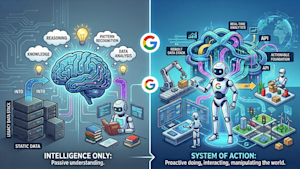
Google's Agentic Data Cloud Transforms Enterprise Analytics
Google has fundamentally reimagined enterprise data infrastructure with the announcement of its Agentic Data Cloud at Cloud Next on Wednesday, April 19, 2026. This revolutionary architecture addresses a critical challenge facing modern businesses: traditional data stacks built for human-driven queries are breaking down as AI agents increasingly operate autonomously around the clock on behalf of organizations.
The tech giant's solution represents a paradigm shift from human-centric data analysis to agent-driven automation, featuring three core pillars designed to support continuous AI operations. At the heart of this transformation is the Knowledge Catalog, which automates semantic metadata curation and infers business logic from query logs without requiring manual data steward intervention.
Breaking Down Google's Agentic Data Cloud Architecture
The Agentic Data Cloud's architecture fundamentally differs from traditional enterprise data stacks by prioritizing real-time, autonomous operations over scheduled human interactions. The Knowledge Catalog serves as the intelligent foundation, automatically understanding and organizing data relationships in ways that AI agents can immediately comprehend and act upon.
This automated semantic layer eliminates the bottleneck of manual metadata management that has long plagued enterprise data operations. Traditional systems required data stewards to manually catalog and maintain business logic, creating delays and potential inconsistencies. Google's approach leverages machine learning to continuously analyze query patterns and automatically infer semantic relationships, enabling AI agents to understand data context without human intervention.
The system's design philosophy centers on enabling autonomous decision-making at scale. While traditional data warehouses excel at serving scheduled reports to human analysts, they struggle to support the continuous, context-aware queries that modern AI agents require. Google's architecture addresses this gap by providing persistent semantic understanding that agents can access instantaneously, regardless of the time of day or query complexity.
Beyond the Knowledge Catalog, the Agentic Data Cloud incorporates cross-cloud capabilities that enable seamless data integration across different environments. This multi-cloud approach ensures that AI agents can access and correlate information from diverse sources without being constrained by traditional data silos or vendor lock-in scenarios.
The Fundamental Shift from Human-Driven to Agent-Driven Data
The emergence of autonomous AI agents has exposed critical limitations in how enterprises structure their data operations. As one industry analysis noted, "Enterprise data stacks were built for humans running scheduled queries. As AI agents increasingly act autonomously on behalf of businesses around the clock, that architecture is breaking down — and vendors are racing to rebuild it."
Traditional enterprise data infrastructure operated on predictable patterns: business analysts would run weekly reports, dashboard updates occurred on scheduled intervals, and data queries followed established workflows during business hours. This human-centric model worked effectively when people served as the primary interface between data and business decisions.
However, AI agents operate fundamentally differently. They require continuous access to real-time data, immediate semantic understanding of business context, and the ability to execute actions based on insights without waiting for human approval. These agents don't work within traditional business hours or follow predictable query patterns — they respond to events, market changes, and operational triggers as they occur.
The architectural mismatch has created significant operational challenges. Legacy systems struggle to provide the low-latency, high-frequency access patterns that AI agents demand. More critically, traditional data cataloging approaches rely heavily on human expertise to define business rules and semantic relationships, creating knowledge gaps that prevent agents from making informed decisions independently.
Google's response addresses these challenges through automated intelligence that operates at machine speed rather than human pace. The Agentic Data Cloud continuously learns from usage patterns, automatically updates semantic understanding, and maintains real-time data availability that matches the operational requirements of autonomous AI systems.
Industry Implications and Competitive Landscape
Google's announcement signals a broader industry transformation as major cloud providers recognize the need to rebuild fundamental data infrastructure for the AI-driven era. This shift represents more than incremental improvement — it's a complete architectural rethinking that could determine which platforms successfully support next-generation business operations.
The timing of this announcement is particularly significant given the rapid adoption of AI agents across enterprise environments. Organizations are increasingly deploying autonomous systems for customer service, supply chain optimization, financial analysis, and operational monitoring. These applications require data infrastructure that can support continuous operation without human bottlenecks.
Competitors including Microsoft, Amazon Web Services, and specialized data platform vendors are likely developing similar agent-centric architectures. The race to rebuild enterprise data stacks represents a multi-billion dollar opportunity, as organizations will need to modernize their infrastructure to remain competitive in an AI-driven business environment.
For enterprise customers, Google's approach offers potential advantages in operational efficiency and decision-making speed. Organizations using the Agentic Data Cloud could deploy AI agents that respond to business events in real-time, optimize operations continuously, and identify opportunities without waiting for scheduled analysis cycles.
However, the transition also presents challenges. Enterprises must evaluate whether to migrate existing data infrastructure, integrate hybrid approaches, or maintain parallel systems during the transition period. The success of Google's platform will largely depend on how effectively it can demonstrate clear business value while minimizing implementation complexity.
Technical Innovation and Semantic Understanding
The Knowledge Catalog's automated semantic metadata curation represents a significant technical achievement in enterprise data management. Traditional approaches to semantic understanding required extensive manual effort from data engineers and business analysts to define relationships, business rules, and contextual meaning within data sets.
Google's system leverages advanced machine learning techniques to analyze query logs and automatically infer business logic patterns. This approach enables the platform to understand not just what data exists, but how different data elements relate to business processes and outcomes. The system can identify which metrics drive key business decisions, how different data sources correlate, and what contextual factors influence data interpretation.
This automated intelligence becomes particularly valuable as data volumes and complexity continue growing exponentially. Manual semantic curation simply cannot scale to handle the vast amounts of structured and unstructured data that modern enterprises generate. Google's approach promises to maintain semantic understanding automatically, adapting to new data sources and evolving business requirements without human intervention.
The cross-cloud integration capabilities further enhance the platform's value proposition by enabling semantic understanding across distributed data environments. Many enterprises operate multi-cloud strategies or maintain data across on-premises and cloud environments. The Agentic Data Cloud's ability to maintain consistent semantic understanding across these diverse environments could significantly simplify data operations and improve AI agent effectiveness.
Expert Analysis and Market Response
Industry experts view Google's Agentic Data Cloud as a critical evolution in enterprise data architecture that addresses genuine operational challenges facing modern organizations. The platform's focus on autonomous operation aligns with broader trends toward AI-driven business processes and the need for real-time decision-making capabilities.
Data architecture specialists particularly praise the automated semantic understanding capabilities, noting that manual metadata management has long been a bottleneck in enterprise data operations. The ability to automatically infer business logic from usage patterns could significantly reduce the time and expertise required to maintain effective data governance.
However, some analysts express concerns about the complexity of transitioning from established data infrastructure to agent-centric architectures. Organizations have invested heavily in existing data warehouses, business intelligence tools, and analytics workflows. The success of Google's approach will depend partly on how effectively it can integrate with or replace these established systems.
Security and governance experts also highlight the importance of maintaining appropriate controls and audit capabilities in agent-driven environments. While autonomous operation offers significant efficiency benefits, organizations must ensure that AI agents operate within appropriate boundaries and maintain compliance with regulatory requirements.
Future Implications and What to Watch
The introduction of agent-centric data architecture represents the beginning of a fundamental shift in how enterprises approach data operations. Organizations should expect to see similar announcements from other major cloud providers as the industry recognizes the need to support autonomous AI operations.
Key developments to monitor include integration capabilities with existing enterprise systems, pricing models for continuous operation versus traditional batch processing, and the emergence of industry-specific adaptations for healthcare, finance, manufacturing, and other regulated sectors.
The success of Google's Agentic Data Cloud will likely be measured by adoption rates among enterprise customers and demonstrated improvements in operational efficiency and decision-making speed. Organizations considering this platform should evaluate pilot programs that can demonstrate value while minimizing implementation risk.
For more tech news, visit our news section.
Transforming Personal and Professional Productivity
The shift toward agent-driven data architecture has profound implications for individual productivity and health optimization. Just as enterprises are deploying AI agents for autonomous decision-making, individuals can leverage similar technologies to optimize personal wellness, work performance, and life balance. Platforms that understand your behavioral patterns, health metrics, and productivity goals can provide real-time insights and recommendations without requiring constant manual input or analysis. Join the Moccet waitlist to stay ahead of the curve in personal optimization technology.