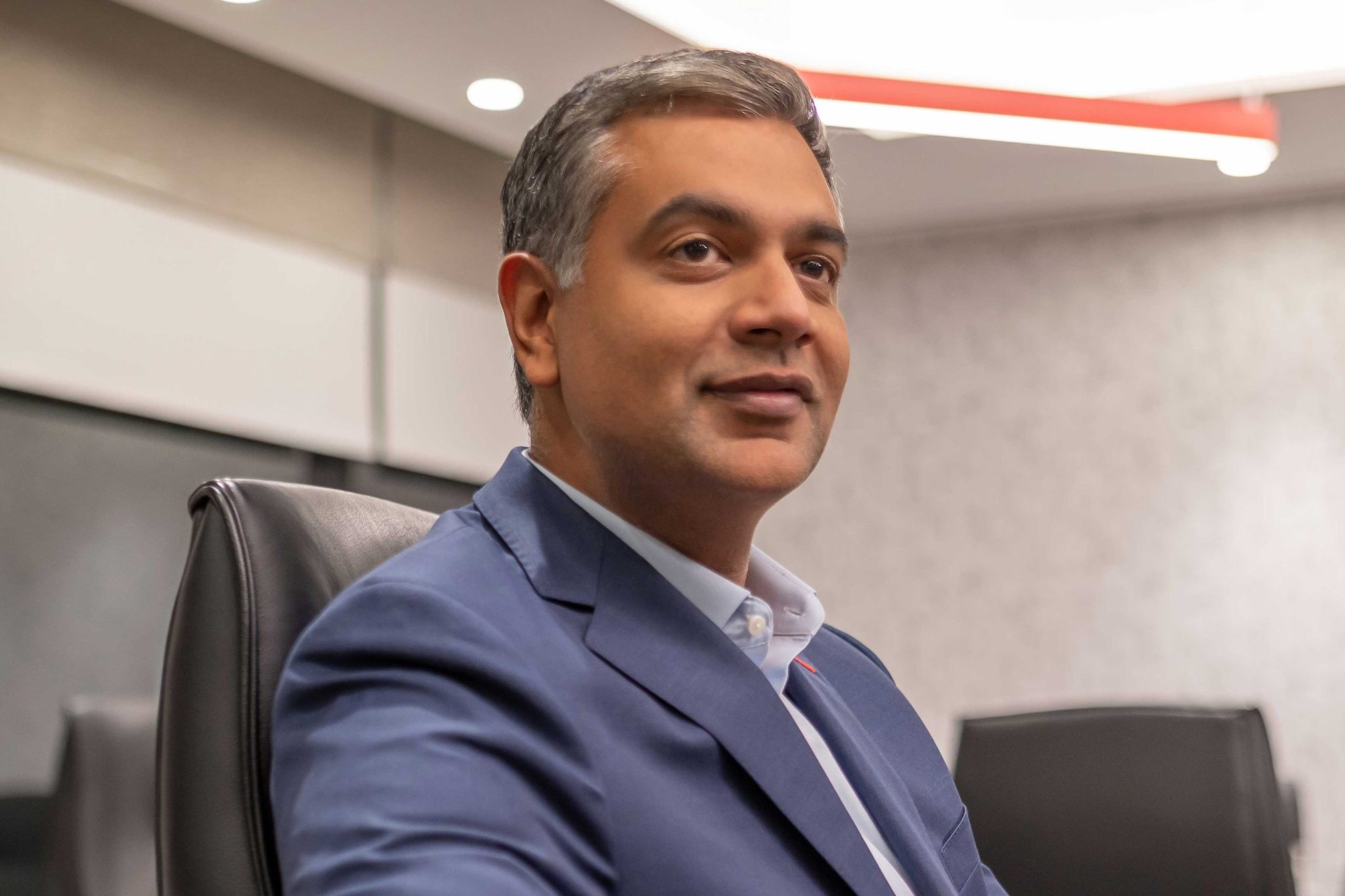
CEO's AI Clone Led a Live Earnings Call — And He's Not Alone
Customers Bank CEO Reveals His AI Clone Delivered Earnings Remarks Live
On April 27, 2026, analysts listening to Customers Bank's first-quarter earnings call received an unexpected disclosure: the prepared remarks they had just heard were not delivered by CEO Sam Sidhu. They were delivered by his AI clone. Approximately one-third of the way into the call, Sidhu revealed the switch, describing the move as something that "may be a first in the history of public company earnings calls." The moment was not a gimmick. It was timed deliberately to coincide with the announcement of a sweeping multiyear partnership between the $25.9 billion bank and OpenAI — and it signaled how aggressively Sidhu is positioning Customers Bank as an AI-native financial institution.
"The prepared remarks you heard on my behalf today were delivered by my AI clone, not read by me," Sidhu told call participants, according to American Banker and CNBC. "The execution of this call itself is a live demonstration of what we mean when we say AI is not an experiment at Customers Bank."
Sidhu's move places him in a fast-growing cohort of major executives deploying AI versions of themselves in corporate settings. Meta CEO Mark Zuckerberg is reportedly building a photorealistic 3D AI clone of himself. Zoom CEO Eric Yuan used an AI-powered digital likeness to deliver opening remarks during the company's Q1 2026 earnings call. And Klarna CEO Sebastian Siemiatkowski has used an AI avatar to present quarterly financial updates. What was once the territory of science fiction is now showing up in investor relations calendars.
The OpenAI Partnership: Engineers Embedded, Targets Set
The AI clone reveal was not the only headline to come out of Customers Bank's Q1 2026 earnings call. Sidhu simultaneously announced that the bank has signed a multiyear partnership with OpenAI under which OpenAI engineers will be embedded directly inside the bank's operations. Customers Bank first began working with OpenAI in 2023; the April 2026 deal broadens that relationship significantly, targeting automation of lending, client onboarding, and payments workflows.
The scale of AI adoption already underway at the bank is notable. According to American Banker, 75% of Customers Bank's employees currently use tools powered by OpenAI, and bank employees have built more than 500 agents and custom AI models. According to CNBC, AI already generates approximately half of the bank's internal software code, and the bank has saved 28,000 hours of work — the equivalent of not hiring approximately 15 full-time employees.
The financial targets attached to the OpenAI partnership are specific. According to CNBC, the bank is aiming to improve its efficiency ratio from approximately 49% to the low 40s, with improved returns expected starting in 2027. On the operational side, the partnership is designed to compress commercial loan closing timelines from a current range of 30 to 45 days down to approximately seven days. Complex commercial account openings, which currently take more than a day, are targeted to fall under 20 minutes using conversational AI and automated document gathering.
Sidhu has framed the OpenAI relationship as one that goes beyond licensing software. "This strategic collaboration with OpenAI gives us the frontier models, engineering expertise and ability to co-create a roadmap toward becoming an AI native bank," he said, according to American Banker. He also suggested the bank's work with OpenAI could generate products with broader industry applications: "We're going to be co-creating enterprise solutions they could potentially sell to other banks in the future."
Manuel Navas, an analyst at Piper Sandler, highlighted what distinguishes this arrangement from typical vendor relationships. "What differentiates this arrangement is that OpenAI's personnel will be embedded in [Customers'] operations to improve its AI tools," Navas said, according to American Banker. In a press statement supporting the partnership, Denise Dresser said: "We are proud to support Customers Bank as they build a more intelligent operating model that empowers employees, strengthens client service, and sets a new standard for regional banking."
Customers Bank's Q1 2026 financials provided context for the AI push. According to the earnings call transcript via Insider Monkey, deposits grew 14% year-over-year and loans grew 15% year-over-year during the quarter.
The AI Clone Trend: Zuckerberg, Yuan, and Siemiatkowski
Sidhu's earnings call moment is striking, but it did not emerge in a vacuum. A pattern of executive AI avatars has been building across industries throughout 2025 and into 2026.
The highest-profile parallel development is at Meta. According to a Financial Times report from April 13, 2026, as covered by Engadget and multiple other outlets, Meta is developing a photorealistic, 3D AI clone of CEO Mark Zuckerberg. The clone is being trained on his mannerisms, tone, publicly available statements, and recent thinking on company strategy, with the stated intent of enabling it to interact with employees. According to reporting citing three unnamed insiders, Meta recently pivoted to prioritize the Zuckerberg AI character over other 3D character projects. Zuckerberg is said to be personally involved in training and testing his animated AI double. Meta has disclosed plans to deploy between $115 billion and $135 billion in capital expenditures in 2026, primarily directed at AI infrastructure, according to Yahoo Finance and WebProNews.
At Zoom, CEO Eric Yuan used his AI-powered digital likeness — built using Zoom's own AI Companion feature — to deliver his portion of the company's Q1 2026 earnings remarks. "Today, I am using our custom virtual avatar, powered by AI, to share part of my report," Yuan said, according to AIBase.com. That Yuan chose to demonstrate the technology during an earnings call — the most scrutinized communication a public company delivers — underscores how seriously at least some executives are taking the practical deployment of AI avatars in high-stakes settings.
Klarna CEO Sebastian Siemiatkowski has similarly used an AI avatar to present quarterly financial updates and to interact with staff and customers, according to People Management and Business Standard. Klarna, which has been aggressive about AI-driven headcount reduction in recent years, has made the Siemiatkowski avatar a recurring feature of its corporate communications.
Why This Matters: Efficiency, Trust, and the Limits of Authenticity
The emergence of executive AI clones in formal corporate communications raises legitimate questions about transparency, trust, and accountability — but the business logic driving the trend is grounded in a real problem. According to a Harvard Business School study of 27 CEOs and 60,000 hours of work, cited by Raconteur, 72% of chief executives' time is spent in meetings. Against that backdrop, the appeal of delegating scripted, high-repetition communication tasks to a trained AI likeness is straightforward.
For Customers Bank specifically, the AI clone was not deployed as a replacement for Sidhu's judgment or decision-making. The prepared remarks — a largely scripted portion of any earnings call — were the vehicle. Sidhu was present on the call and continued to participate. The distinction matters: delivering pre-written text is a task well within what current AI voice and avatar technology can execute with high fidelity. The more open question is where the boundary lies between acceptable automation and the kind of impersonation that erodes investor or employee confidence.
Sidhu's decision to disclose the AI clone's role during the same call — rather than afterward or not at all — suggests an awareness of that boundary. The disclosure itself became the demonstration. Whether other executives who follow the trend will be as forthcoming remains to be seen.
On the banking side, the specific targets Customers Bank has attached to its OpenAI partnership give the initiative more measurable stakes than a communications stunt alone would imply. Cutting commercial loan timelines from up to 45 days to approximately seven days, if achieved, would represent a meaningful operational shift. The efficiency ratio target — moving from approximately 49% to the low 40s — is a standard financial metric that will be tracked by analysts in subsequent quarters. The promise of improved returns starting in 2027 creates a defined window in which the partnership will be evaluated.
The embedding of OpenAI engineers directly within the bank's operations is also structurally different from a standard software licensing arrangement. It creates a closer integration between the bank's domain expertise and OpenAI's model development, and Sidhu has suggested it could produce enterprise products applicable to other financial institutions. If that co-creation model proves productive, it could become a template for how AI companies deepen relationships with regulated industries beyond simply providing API access.
What Comes Next
For Customers Bank, the immediate milestones are operational. The OpenAI partnership targets are tied to 2027 financial results, meaning the next several quarters will serve as early indicators of whether the embedded engineering model is producing the workflow transformations Sidhu has described. Loan closing timelines and account onboarding speeds are measurable, and analysts will have the opportunity to track reported efficiency ratios against the stated targets.
The broader trend of executive AI avatars is unlikely to slow. As the technology producing photorealistic voice and video likenesses becomes more accessible and less expensive, the barrier to deploying an AI clone for scripted communications continues to fall. The Customers Bank earnings call, Meta's reported Zuckerberg project, and Zoom's Yuan demonstration each represent different points on a spectrum — from voice-only AI delivery to full 3D photorealistic interaction. The trajectory suggests more executives will experiment with some version of this in the near term.
What remains genuinely open is how regulators, investors, and employees will respond as the practice becomes more common. Earnings calls are regulated communications subject to SEC disclosure rules. Whether an AI-delivered prepared remark — when disclosed — satisfies existing requirements, or whether new guidance will emerge, is a question that financial regulators have not yet addressed publicly based on available reporting.
Sidhu's framing of the AI clone as a "live demonstration" rather than a shortcut positions it as proof of concept for the bank's broader AI strategy. The bet is that the operational results will validate the approach. The 2027 targets will be the clearest test of that argument.
For more tech news, visit our news section.