
Introducing moccet-connect
Social networks got the direction of travel wrong.
Every major platform points inward. The feed is designed to keep you in the feed. The content is designed to make you consume more content. The algorithm optimises for the amount of time you spend looking at your phone. This is not a conspiracy. It is the logical output of an advertising business model. When revenue comes from attention, the product must capture attention.
The result is a strange inversion. The average person has more tools for connection than at any point in human history, and less of it. The data is clear. Loneliness in adults under 25 is at 61%. The average person has not made a new friend in five years. The tools got better. The outcomes got worse.
We think the best thing a screen can do is give you a reason to put it down. AI already knows what you care about, where you are, and when you are free. That is enough to surface the right person, the right place, and the right moment, things you would never have found on your own.
Today we are introducing moccet-connect, the social layer of the moccet app.
How we got here
moccet is your personal AI. It reads your calendar, your nutrition, your training, your sleep, your email, what you read, what you search. Over time it builds a continuous understanding of what you are doing and what you care about.
At some point we noticed something. moccet knew when two people who would enjoy meeting were in the same neighbourhood at the same time, both free for the next two hours. It knew your friend finished a run on a route you would love. It knew someone nearby was reading the same research. It knew the person across the room shared three of your interests and had no idea you existed.
The information was already there. Nobody was connecting it. In our pursuit to elevate the human experience, we built the thing that does.
The feed
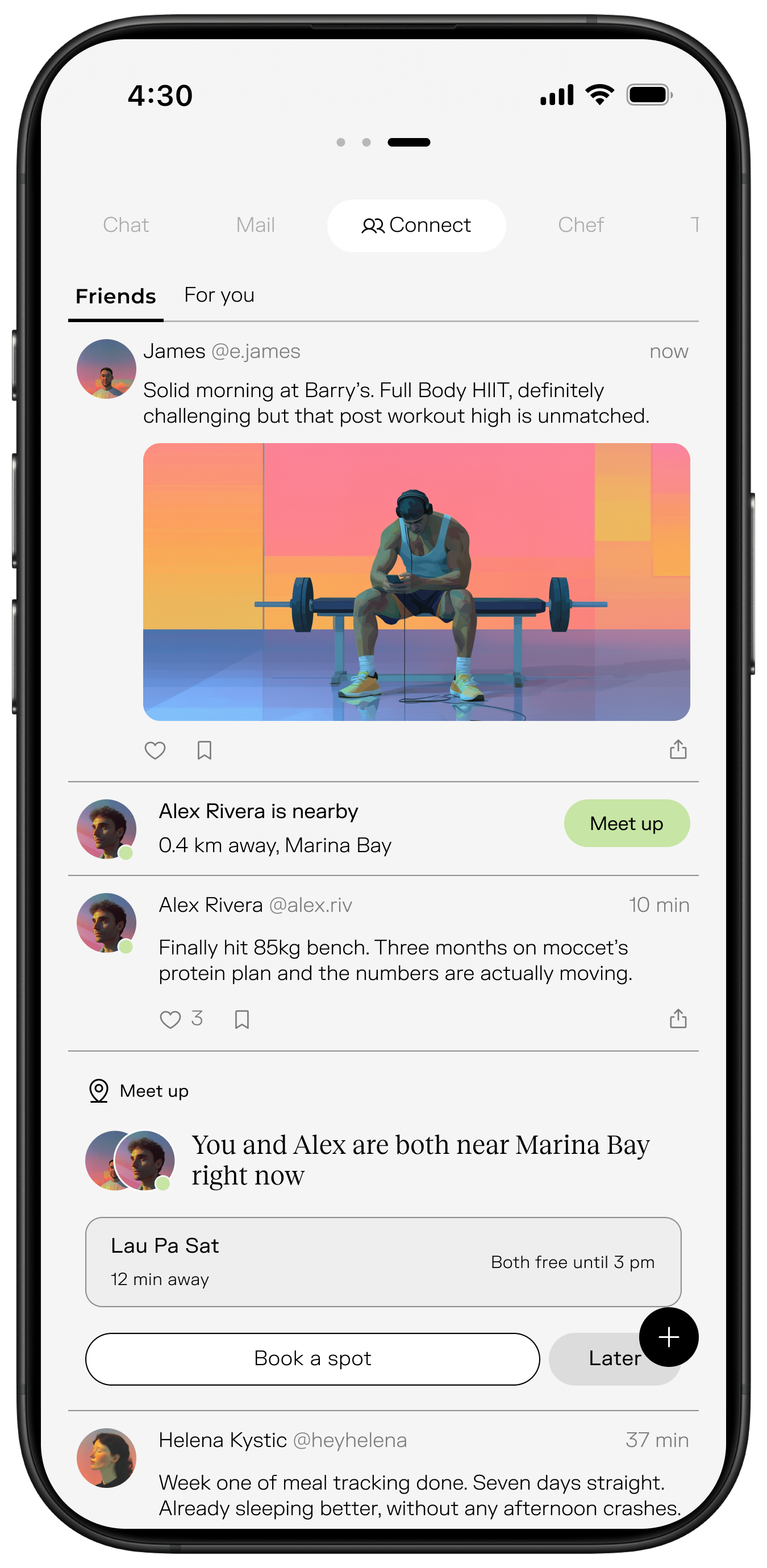
moccet-connect has two tabs. Friends shows what the people you know are doing. For You introduces people you do not know yet but probably should.
The Friends feed is not a performance space. There are no follower counts. No comments. No public metrics. Connections are mutual, like actual friendships. Everything is moderated by AI before it publishes. The feed stays constructive because the architecture requires it, not because a policy requests it.
Most of the posts are drafted by moccet. You finish a workout, and the app writes a post in your voice. You book a restaurant, and a card appears with the venue and a reservation button for anyone who wants to go. You save an article, and a summary appears in the feed with a personalised insight for each reader based on their own data. You do not have to think about what to post. The system already knows. You just approve.
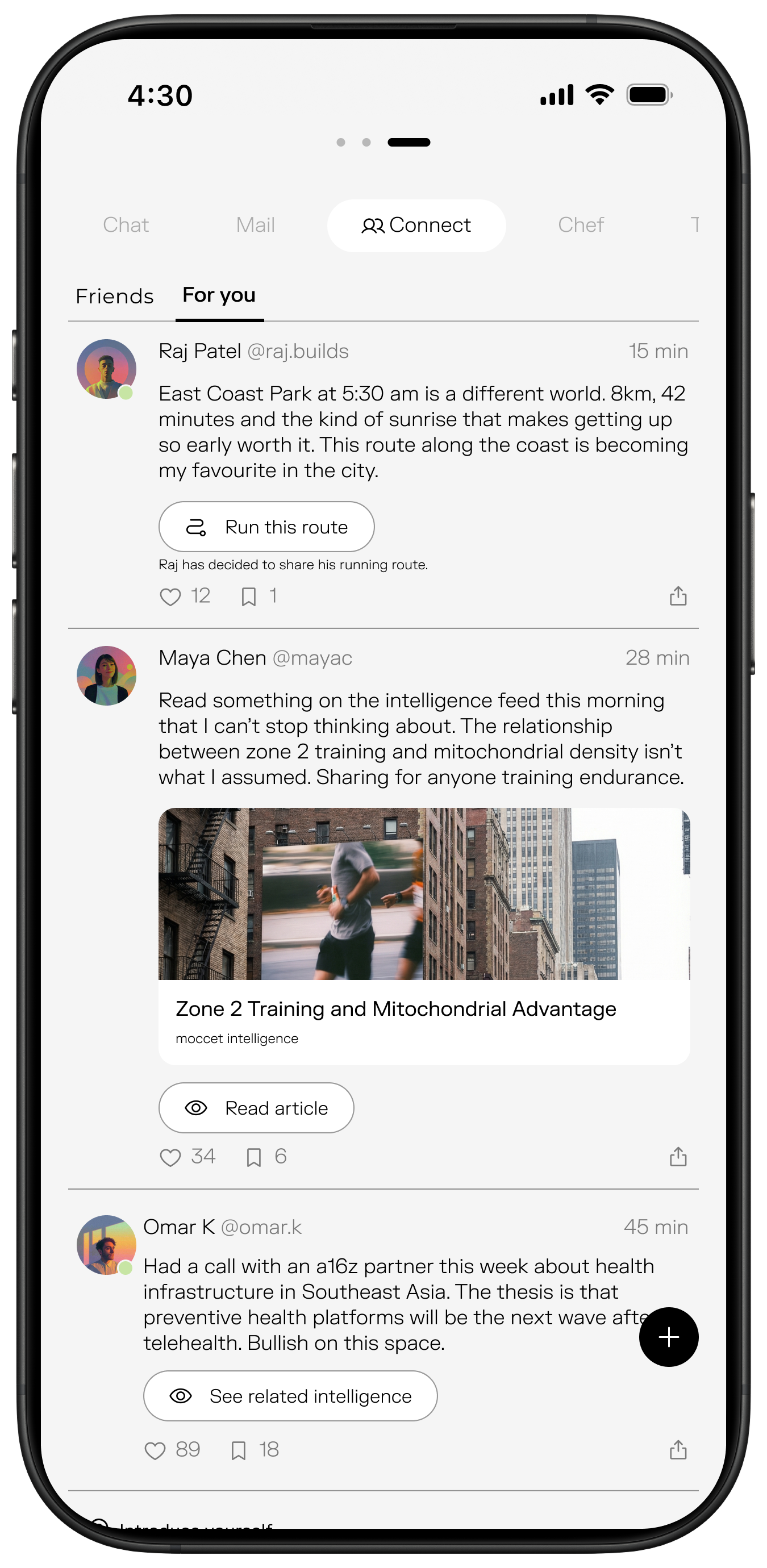
The For You tab is where things get interesting. A runner who trains your distances. A founder nearby working on similar problems. Someone who reads what you read. Each person appears with a line explaining the connection. When the match is strong enough and you are both nearby, a card appears. Not a notification. A quiet introduction. A venue. A time. A button that says Make a reservation.
What a post actually does
Every social platform has posts. Very few of them lead anywhere. A post about a restaurant does not let you book the restaurant. A post about a book does not let you buy the book. A post about a running route does not let you run the route.
In moccet-connect, it does.
Your friend shares a route along the coast. You tap it. You see the map, the distance, the elevation, the surface type. moccet tells you the terrain suits your recovery state after yesterday's upper body session. It recommends a window tomorrow morning based on the weather and your calendar. Three friends ran it this month. One of them posted a time you want to beat.
Someone shares an article on zone 2 training. You tap it. The full piece opens with 12 sources. At the top, a personalised callout. Your last four weeks of training were 78% zone 3 and 4. Zone 2 work could improve recovery between the heavier sessions your trainer has planned. The article is the same for everyone. The insight is yours.
A founder posts about a conversation with an investor on health infrastructure in Southeast Asia. You tap See related intelligence. moccet compiles a briefing. Market size, growth rate, competitive landscape, recent fundraises, regulatory environment. Not a summary of the post. An original research piece triggered by it.
Someone mentions a meal plan. You see the full protocol, macros, recipes. Someone recommends a book. You buy it. Someone posts about a studio. You book a class. The distance between seeing something and doing something about it is one tap.
When people are close
When two friends are near each other with open calendars, a card appears in the feed. You and Alex are both near Marina Bay right now. Lau Pa Sat, twelve minutes away. Both free until 3pm. You tap it. Choose the time, the party size, the place. The system books it, adds it to both calendars, sends a reminder.
The same thing happens with strangers the system thinks you should meet. The card says Introduce yourself instead of Meet up. The venue is suggested. The time is suggested. You confirm or you do not. No pressure. No awkwardness. Just an opportunity that would have gone unnoticed.
This matters more than it appears to. Research in Frontiers in Psychology found that bridging social capital, meeting diverse new people, has a 4.4x stronger effect on wellbeing than bonding capital, deepening existing relationships. The introduction card is not a feature. It is the point of the product.
Ask your network
At the bottom of the feed, a search bar. Ask anything about your network. Who ran more than 10k this week. Who has been to that restaurant you have been meaning to try. Who is reading what you are reading. Who is in Tokyo the same week you are.
The feed shows you what is happening. The search bar lets you find what you are looking for.
We think the measure of a social product is simple. Not how long you spend in it. Whether the people in your life become more present in your week.
Pre-order moccet at moccet.ai. For early access, email team@moccet.com.
Frequently asked questions
What is moccet-connect? moccet-connect is an AI-native social feed inside the moccet app. It drafts posts from your daily activity, moderates all content for positivity, and facilitates real-world meetups between friends and new connections through venue selection, booking, and calendar coordination. Every post connects to actionable content across the moccet platform.
How is moccet-connect different from other social apps? There are no follower counts, no comments, no public engagement metrics, and no advertising. Posts lead to real actions: booking restaurants, running routes, reading research, buying books. The feed is optimised for real-world meetings, not screen time.
How does moccet-connect protect my privacy? Location is stored as a neighbourhood-level approximation and deleted within hours. Health and calendar data are processed on your device. Ghost Mode disables all proximity features instantly. All data is encrypted and deletable at any time.
What does it cost? moccet-connect is included in the moccet app. Free to download with advanced features on Pro and Max subscriptions. Pre-order moccet at moccet.ai.
How do I get early access? Pre-order moccet at moccet.ai or email team@moccet.com for TestFlight access.